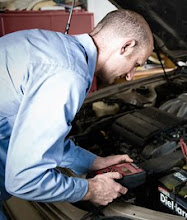
The suspension of a car is a simple system when compared to the those things related to the drivetrain, and because of this steering just gets lumped in with it in tests and diagnostics. When most people think of suspension a picture of a shock comes to mind: a sausage shaped piece of metal that is bolted on somewhere between a wheel and the frame of a vehicle. When air shocks and struts became standard on cars, the terminology began confusing owners and students alike. Throw a random name like McPhearson Strut out there and a sizeable portion of shade-tree mechanics threw in the towel on performing their own repairs due to terminilogical complexity. The truth is that the shock hasn't evolved all that much through the years. By itself it can be described sa an oil filled cannister that is contained by a couple of rubber seals. When the car goes over a bump (more unused terminology here) it jounces and rebounds...or goes up and down. The oil inside the shock has a finite ability to compress and this is what keeps the car from chattering down the street, the absorbsion of a road's hills and valleys into the cannister and away from the frame.
The simple shock still exists en masse with trucks and SUVs that are weighty and require regular shock replacement. But suspension is more than just shocks. There are control arms and drag links, sway bars and ball joints. However, the recipe does not get any more complex. These items absorb impact at the wheel, behind the wheel or simply keep the wheel on the ground.
Steering is more complex, especially with its ever-evolving engineering. It seems hard to believe, but there are still many newer cars that do not have power steering, an advancement that changed drivers from a handful of decent parallel-parkers to a whole contigent. Most cars do have this feature and this system's expansive conflagration of squirrely pressure and return lines, coolers and filters, racks and linkage, pumps and pulleys make it a fantastic money-maker for repair shops across the land. The adoption of drive by wire or computer-controlled power steering will expand this repair work well beyond the scope of any at-home mechanic with a Craftsman set of wrenches and a clean garage with a couple of floor jacks.
Although not as quickly as the internet or cell phones, the automotive world is expanding at a rapid pace and the heavy tome we were instructed to buy when our class began had already become outdated. We were trying as hard as we could to understand things that were not that hard to grasp. Meanwhile, outside our doors, the world moved on in such a way that the small slice of students that would actually complete their courses would be eating the dust of improvements that had come and gone.
Monday, February 21, 2011

Thursday, January 27, 2011
Charlie
Whereas the learning was slow with engine repair, and the absurdly high number of students who struggled with education in general, in steering and suspension we ground to a halt. The thin rope Brad had woven between education and experience was fraying and then unraveling before his eyes and he became dejected and removed. The addition of a teenage girl to the class wiped clean a whole week of learning as Brad's lessons were constantly interrupted either by petty remarks of the young men surrounding this girl and trying desperately to impress her, or by her own attempts to draw attention to herself by emphatically raising her hand and asking the most inane questions. She dressed provocatively and could at any moment be scanning the class for potential boyfriends while Brad's feeble lecture continued.
Her expulsion from the class a week after it began, and its ultimate affect on the class, paled in comparison to the addition of Charlie. Invited to join class despite some serious mental disability he had, the derision he received from some of the younger members of the group was immediate and ruthless. He, too, would raise his hand often to ask Brad obtuse questions, but lacking the endowments of our former Miss Teen USA, his interrogations were met with abject disdain from the pot-smoking contingent of our class. At first those around him would snicker and talk under their breath, but as the class wore on, his emboldened torturers would begin to shout for him to "shut up" and "get the f*&% out of here" and call him "retard".
Brad, for whatever reason, failed to put a stop to the mayhem. He may have been addressing the issues behind closed doors, but it was an option which was bearing no fruit. Charlie did get adopted into David's group, which helped put a protective barrier between himself and his detractors, but whenever he strayed from his pack the wolves would attack.
One afternoon in the garage I was aware of a high-pitched altercation in the garage adjascent to the the thin-walled lunch area. Rounding the corner I found Charlie surrounded by the ganja gangsters. They were shouting something at him and as he would back away from his abuser, another would approach from behind and push him back into the square formed around him like a boxing ring. Charlie was not a small dude. Even hunched he appeared to be around six-foot three and underneath the baggy clothes he wore it was hard to determine what strengths lay hidden. He donned a scraggly beard and his eyes were intense even while obscured under the brim of the ball-cap he wore daily. He was becoming observably agitated and the crimson color rising in his cheeks foretold of an explosion. None of us knowing Charlie's history, it was hard to say what would happen when the limit was reached and the reactor went into the red. The episode was making me nervous and I approached the group to say something, but as quickly as it had begun, it ended. The foursome who needled at Charlie dispersed into the blackened depths of the garage and Charlie was left breathing heavily and with a faraway feeling about him. I noticed Brad and a group of students entering the garage and though they had not noticed what had happened, they had influenced the premature departure of the evil-doers.
"Are you okay?" I asked Charlie. He did not look at me, but kept his eyes pinned to the shadowy recesses of the bays where the wolves awaited him.
"They better leave me alone or..."
"Or what?" I asked after a time.
"They better just leave me alone," he spurted and then darted off himself. But, they didn't and things just seemed grow more intense with each passing day.
Her expulsion from the class a week after it began, and its ultimate affect on the class, paled in comparison to the addition of Charlie. Invited to join class despite some serious mental disability he had, the derision he received from some of the younger members of the group was immediate and ruthless. He, too, would raise his hand often to ask Brad obtuse questions, but lacking the endowments of our former Miss Teen USA, his interrogations were met with abject disdain from the pot-smoking contingent of our class. At first those around him would snicker and talk under their breath, but as the class wore on, his emboldened torturers would begin to shout for him to "shut up" and "get the f*&% out of here" and call him "retard".
Brad, for whatever reason, failed to put a stop to the mayhem. He may have been addressing the issues behind closed doors, but it was an option which was bearing no fruit. Charlie did get adopted into David's group, which helped put a protective barrier between himself and his detractors, but whenever he strayed from his pack the wolves would attack.
One afternoon in the garage I was aware of a high-pitched altercation in the garage adjascent to the the thin-walled lunch area. Rounding the corner I found Charlie surrounded by the ganja gangsters. They were shouting something at him and as he would back away from his abuser, another would approach from behind and push him back into the square formed around him like a boxing ring. Charlie was not a small dude. Even hunched he appeared to be around six-foot three and underneath the baggy clothes he wore it was hard to determine what strengths lay hidden. He donned a scraggly beard and his eyes were intense even while obscured under the brim of the ball-cap he wore daily. He was becoming observably agitated and the crimson color rising in his cheeks foretold of an explosion. None of us knowing Charlie's history, it was hard to say what would happen when the limit was reached and the reactor went into the red. The episode was making me nervous and I approached the group to say something, but as quickly as it had begun, it ended. The foursome who needled at Charlie dispersed into the blackened depths of the garage and Charlie was left breathing heavily and with a faraway feeling about him. I noticed Brad and a group of students entering the garage and though they had not noticed what had happened, they had influenced the premature departure of the evil-doers.
"Are you okay?" I asked Charlie. He did not look at me, but kept his eyes pinned to the shadowy recesses of the bays where the wolves awaited him.
"They better leave me alone or..."
"Or what?" I asked after a time.
"They better just leave me alone," he spurted and then darted off himself. But, they didn't and things just seemed grow more intense with each passing day.
Monday, January 24, 2011
Steering and Suspension
By some strange act of God, we made it through Engine Repair with no blood spilled, bones broken or overly concerning lacerations to become the lore of future class introductions for Brad. And, although the class has become a slimmed down version of its original form, even some of the drug-addled teenagers had wheedled their way under the bar and into the next session of steering and suspension.
Had I been released at exactly that moment to some shop where I was required to remove, overhaul and replace an engine, then trouble would have arisen. The true art of car repair, and I did consider it an art, was one built by constant repetition of repair work perpetuated most often by young men and women under the tutelage of parents and neighbors; and who never spent a dime on formal education in their early years. The single removal of an engine would never give me more than a passing knowledge of the intricacies required to become a skilled technician.
At the time, though, this did not cast any dispersion onto the goal I had set for myself of completing the two years required to pass the class and get my ASE certifications. Steering and suspension, I assumed, would be a logical continuation of work started by those who had worm holed their way past the introductory session of engine repair. Instead, the doors of welcome were flung open and the seats were refilled with a whole new set of eager students. There were no objections raised by the first-session crew who had been given the insightful, but ultimately fruitless introduction about safety and rules, when it was omitted from the beginning of session two; and no inquisition by new students about these procedures when they were thrust into the fold. There was only a passing reference made by Brad about taking cues from the first session veterans concerning the direction that was to be taken. So, by this method, the new students were to become as nonplussed as we were, in the realm of safety glasses, steel-toed shoes, long pants or any other protective bits of clothing that might have saved them some skin or appendage. Brad must have concluded that the dirt and grime of the work we were performing to be inspiration enough to seek clothing appropriate for the work to be completed.
I felt initially disenchanted by the intrusion of new faces into a configuration that was just starting to feel comfortable. I understood that the school had to make money, and could not do so with a class pared down to a few groups of four people, many of whom were not funding the automotive repair class directly. But, after a couple of weeks the addition a many faces also helped with the everyday drama that arose with fresh personalities.
By far the most interesting group to gestate from the incubated warmth of the upstairs classroom was one led by a member of an O.G. engine repair student named David, who had recently been released from duty in the armed services, and was trying to find work as a B-level technician in a shop to pay the bills. He did not seem to have charted much of path beyond this and was not worried about any outcome save for gainful employment. He was, hands down, the nicest person who I would meet in the mixed bag that made up my classmates. Always smiling and laughing about something and greeting me, I had invited him to become a part of our group. Yet, he seemed to have a loyalty to those with whom he had begun the session. When he did switch groups for the second session, it was for a group whose needs were much greater than ours for him.
In steering and suspension this was an older woman who seemed completely out of place in our midst. Her age and disposition, kind and determined, did not carry the normal attributes associated with mechanical repair. She and David found a bond, I believe, in being some of the few African-Americans remaining in the class. But David's group did not divide by race. They also adopted a quiet Hispanic youth who mostly shrugged and smiled when interrogated about anything, and more importantly, a mentally challenged, mid-twenties man who would literally and figuratively put a wrench into the entire workings.
Had I been released at exactly that moment to some shop where I was required to remove, overhaul and replace an engine, then trouble would have arisen. The true art of car repair, and I did consider it an art, was one built by constant repetition of repair work perpetuated most often by young men and women under the tutelage of parents and neighbors; and who never spent a dime on formal education in their early years. The single removal of an engine would never give me more than a passing knowledge of the intricacies required to become a skilled technician.
At the time, though, this did not cast any dispersion onto the goal I had set for myself of completing the two years required to pass the class and get my ASE certifications. Steering and suspension, I assumed, would be a logical continuation of work started by those who had worm holed their way past the introductory session of engine repair. Instead, the doors of welcome were flung open and the seats were refilled with a whole new set of eager students. There were no objections raised by the first-session crew who had been given the insightful, but ultimately fruitless introduction about safety and rules, when it was omitted from the beginning of session two; and no inquisition by new students about these procedures when they were thrust into the fold. There was only a passing reference made by Brad about taking cues from the first session veterans concerning the direction that was to be taken. So, by this method, the new students were to become as nonplussed as we were, in the realm of safety glasses, steel-toed shoes, long pants or any other protective bits of clothing that might have saved them some skin or appendage. Brad must have concluded that the dirt and grime of the work we were performing to be inspiration enough to seek clothing appropriate for the work to be completed.
I felt initially disenchanted by the intrusion of new faces into a configuration that was just starting to feel comfortable. I understood that the school had to make money, and could not do so with a class pared down to a few groups of four people, many of whom were not funding the automotive repair class directly. But, after a couple of weeks the addition a many faces also helped with the everyday drama that arose with fresh personalities.
By far the most interesting group to gestate from the incubated warmth of the upstairs classroom was one led by a member of an O.G. engine repair student named David, who had recently been released from duty in the armed services, and was trying to find work as a B-level technician in a shop to pay the bills. He did not seem to have charted much of path beyond this and was not worried about any outcome save for gainful employment. He was, hands down, the nicest person who I would meet in the mixed bag that made up my classmates. Always smiling and laughing about something and greeting me, I had invited him to become a part of our group. Yet, he seemed to have a loyalty to those with whom he had begun the session. When he did switch groups for the second session, it was for a group whose needs were much greater than ours for him.
In steering and suspension this was an older woman who seemed completely out of place in our midst. Her age and disposition, kind and determined, did not carry the normal attributes associated with mechanical repair. She and David found a bond, I believe, in being some of the few African-Americans remaining in the class. But David's group did not divide by race. They also adopted a quiet Hispanic youth who mostly shrugged and smiled when interrogated about anything, and more importantly, a mentally challenged, mid-twenties man who would literally and figuratively put a wrench into the entire workings.
Tuesday, December 28, 2010
The Puzzle
Enrolling at Emily Griffith was not necessarily of the incongrous nature it appeared to be. Although in recounting this decision to others later down the road I made it seem to be a clean start borne out of nowhere. But the truth was that it was a puzzle whose pieces were slow in being put together. By making it seem black and white, I added drama to my tale. It wasn't intentional, simply that I had forgotten, myself, where exactly the desire to change had come from. In hindsight, the seed was planted so many years before.
When I lived in Portland, freshly emancipated from the confines of school, I had a full head of dreadlocks, a semi-permanent hemp necklace and a girlfriend whose vegan proclivities rolled over into my denial of the pig and the cow flesh. I lived the ho-hum life of a 90's hippie who was content to spend his nights with friends around a dark and creamy pitcher of home-brew or taking in a dollar rerun with those same friends at the arty Bagdad Theater down the street from our house.
Although my gig at the coffee shop paid the bills and brewhouse tabs, I felt I was being surpassed by my compadres who gravitated toward jobs with futures. Yet, the fog of post-college was too thick to determine what exactly the final outcome of my life would be.
As the money was always too tight for anything extraneous I decided that changing the oil on my car was an easy way to save fifteen dollars better spent on beer.
It is with distinct clarity I can recall wandering into the street in front of our house and rifling through the trunk of my 1986, oxidized Chevy Celebrity for the emergency jack. Once found, I lodged the rickety thing under the pinch weld of the car and elevated it a foot off the ground. The pavement not being even, the vehicle teetered precariously on the jack and despite my serious reservations, I managed to loosen the drain plug and drain the oil. The filter was another matter entirely. I didn't seem to have enough room to get to it without putting my life in jeapordy. Being without health-insurance, as recent college grads are prone to be, even I recognized the danger of the situation. Somehow, with the car rocking wildly back and forth, I was able to twist the oil cylinder free and screw the new one into place. With a huge sigh of relief, I lowered the car and filled it with oil. My arm was coated with a shining black sleeve of grease where the filter had emptied itself and I walked back into the house where, amidst the smirks of my roomates, I changed from my petroleum reeking clothes into my proudly procured 70's hippie garb; and went out for a test drive in the ill-looking, but now well-running Celebrity. The two inch wide roadmarker of oil I laid down on that drive around the block could easily have been mistaken for a the grafitti of a drunken Department of Transportation worker, splitting a street into further division, except that their lines were yellow or white whereas mine was coal-black and slippery. Chances are, even if the city worker were drunk, they would have known how to tighten an oil filter before the angry red "low oil" light came on. When I pulled back into the driveway, and saw the growing puddle of black creeping out from underneath my engine, I pretty much lost my senses and ran screaming into the house with all sorts of colloquial profanity, derived from my father before me, spewing out of my lips. My roomates, many of whom appeared quite stoned, found this whole episode amusing beyond words (which was good because they couldn't really form any). One particular roomate took pity on me and with a olympic dexterity and without use of the scissor jack, reached into the wheel well and gave the filter one more solid turn. Ego bruised, but with problem solved, I did what I had done for years prior: I made the determination then and there that I would not get beat down with humiliation, but rather learn more and avoid the embarrassment and frustration of that moment.
This was not an easy process. I was, after all, the son of a man who filled his crankcase with coolant (or his radiator with oil, he won't exactly admit to either). And there were setbacks (as when I installed the doughnut spare tire backwards, on the side of a highway, with rain pouring down and semi trucks howeling past and the the blight of a hangover hammering at me and a friend hounding me as I did all of this, about how his flight to Germany was leaving in exactly 45 minutes! + Added Bonus: Tire Shop Mechanic's comment: "I've never seen that before!") OK, admittedly there were more than a few setbacks. But the more I fumbled, the harder I tried.
When a engineer friend of mine visited over the summer, someone who found pleasure restoring cars, I spent the entirety of a 5 hour hike grilling him about how engines and transmissions worked. When my beloved Chevy Celebrity vomited coolant after a concert one night and was towed into a shop, I made the mechanic explain in depth how water pumps worked. And so it went. With every breakdown, of which there were many, I learned more and more.
When I moved back to Colorado I began making a habit of doing the minor car repairs for our family. I replaced belts and batteries, alternators and radiators. I moved into that place where I truly became knowledgeable enough that I was dangerous. In fact, I became downright cocky. In replacing an alternator on my 1992 Honda Accord I discovered how tie-rod ends come off, and at the same time made a name for myself in the neighborhood where I grew up as the the greasy guy who had his car on jack stands next to the elementary school for days on end and who was so profane that mothers and children went a block out to there way to get past (that job eventually got redone by a professional mechanic by the way!)
But, I began fixing friend's cars. I actually made them believe that I could do it (uh, their cars ended up going to professional mechanics as well). At least with each ridiculous error I made, I learned something new and stuck another Haynes manual on my bookshelf. The love/hate relationship with this work stuck with me, not because I was particularly handy, but simply because I enjoyed learning and I enjoyed helping. I was always someone who would get bored with something if I had to do it to long, and wanted to always have something else around the bend to educate me. With car repair, I would never run out of challenges and new opportunities even when the walls felt like they were crashing down around me.
When I lived in Portland, freshly emancipated from the confines of school, I had a full head of dreadlocks, a semi-permanent hemp necklace and a girlfriend whose vegan proclivities rolled over into my denial of the pig and the cow flesh. I lived the ho-hum life of a 90's hippie who was content to spend his nights with friends around a dark and creamy pitcher of home-brew or taking in a dollar rerun with those same friends at the arty Bagdad Theater down the street from our house.
Although my gig at the coffee shop paid the bills and brewhouse tabs, I felt I was being surpassed by my compadres who gravitated toward jobs with futures. Yet, the fog of post-college was too thick to determine what exactly the final outcome of my life would be.
As the money was always too tight for anything extraneous I decided that changing the oil on my car was an easy way to save fifteen dollars better spent on beer.
It is with distinct clarity I can recall wandering into the street in front of our house and rifling through the trunk of my 1986, oxidized Chevy Celebrity for the emergency jack. Once found, I lodged the rickety thing under the pinch weld of the car and elevated it a foot off the ground. The pavement not being even, the vehicle teetered precariously on the jack and despite my serious reservations, I managed to loosen the drain plug and drain the oil. The filter was another matter entirely. I didn't seem to have enough room to get to it without putting my life in jeapordy. Being without health-insurance, as recent college grads are prone to be, even I recognized the danger of the situation. Somehow, with the car rocking wildly back and forth, I was able to twist the oil cylinder free and screw the new one into place. With a huge sigh of relief, I lowered the car and filled it with oil. My arm was coated with a shining black sleeve of grease where the filter had emptied itself and I walked back into the house where, amidst the smirks of my roomates, I changed from my petroleum reeking clothes into my proudly procured 70's hippie garb; and went out for a test drive in the ill-looking, but now well-running Celebrity. The two inch wide roadmarker of oil I laid down on that drive around the block could easily have been mistaken for a the grafitti of a drunken Department of Transportation worker, splitting a street into further division, except that their lines were yellow or white whereas mine was coal-black and slippery. Chances are, even if the city worker were drunk, they would have known how to tighten an oil filter before the angry red "low oil" light came on. When I pulled back into the driveway, and saw the growing puddle of black creeping out from underneath my engine, I pretty much lost my senses and ran screaming into the house with all sorts of colloquial profanity, derived from my father before me, spewing out of my lips. My roomates, many of whom appeared quite stoned, found this whole episode amusing beyond words (which was good because they couldn't really form any). One particular roomate took pity on me and with a olympic dexterity and without use of the scissor jack, reached into the wheel well and gave the filter one more solid turn. Ego bruised, but with problem solved, I did what I had done for years prior: I made the determination then and there that I would not get beat down with humiliation, but rather learn more and avoid the embarrassment and frustration of that moment.
This was not an easy process. I was, after all, the son of a man who filled his crankcase with coolant (or his radiator with oil, he won't exactly admit to either). And there were setbacks (as when I installed the doughnut spare tire backwards, on the side of a highway, with rain pouring down and semi trucks howeling past and the the blight of a hangover hammering at me and a friend hounding me as I did all of this, about how his flight to Germany was leaving in exactly 45 minutes! + Added Bonus: Tire Shop Mechanic's comment: "I've never seen that before!") OK, admittedly there were more than a few setbacks. But the more I fumbled, the harder I tried.
When a engineer friend of mine visited over the summer, someone who found pleasure restoring cars, I spent the entirety of a 5 hour hike grilling him about how engines and transmissions worked. When my beloved Chevy Celebrity vomited coolant after a concert one night and was towed into a shop, I made the mechanic explain in depth how water pumps worked. And so it went. With every breakdown, of which there were many, I learned more and more.
When I moved back to Colorado I began making a habit of doing the minor car repairs for our family. I replaced belts and batteries, alternators and radiators. I moved into that place where I truly became knowledgeable enough that I was dangerous. In fact, I became downright cocky. In replacing an alternator on my 1992 Honda Accord I discovered how tie-rod ends come off, and at the same time made a name for myself in the neighborhood where I grew up as the the greasy guy who had his car on jack stands next to the elementary school for days on end and who was so profane that mothers and children went a block out to there way to get past (that job eventually got redone by a professional mechanic by the way!)
But, I began fixing friend's cars. I actually made them believe that I could do it (uh, their cars ended up going to professional mechanics as well). At least with each ridiculous error I made, I learned something new and stuck another Haynes manual on my bookshelf. The love/hate relationship with this work stuck with me, not because I was particularly handy, but simply because I enjoyed learning and I enjoyed helping. I was always someone who would get bored with something if I had to do it to long, and wanted to always have something else around the bend to educate me. With car repair, I would never run out of challenges and new opportunities even when the walls felt like they were crashing down around me.
Sunday, October 17, 2010
The Slow Progress
For all that my lab partners and I lacked, we paled in comparison to the others. At least the cumulative sum of ages in our group added up to an number worthy of trust in the eyes of Brad. He could see right away that we exorcised a certain amount of responsibility and willfulness. This in spite of the fact that one of our members was trying hard to hide a history of unlawful acts. One day when there was a tour of the shop for new, perspective students, a tour attendee looked directly at John and asked, "So, can people who have been in jail come to this school, too?"
"Why the hell would she look and me and ask that?" John complained later. There was absolutely nothing that indicated to any observer that he had been incarcerated or slapped with a felony. Yet, she had looked right at him when posing the question to the tour guide. His forlorn expression following this stint foreshadowed the long road ahead and the battle he was fighting to make a honest name for himself. Still, he simply shrugged and carried on, educating our small unit and carrying us beyond our classmates.
In the far bays, the other groups struggled. Stripped of the older, wiser and more intent members, they were left to rely on a book, a computer program and Brad's snippets of feedback. Additionally, new class members would strangely appear and further dilute the other groups' knowledge base. The arrival of a student in the middle of a class term was not supposed to occur, but the dwindling attendance signaled problems for the class's continuation. The danger posed by this equation was obvious. The new members not only slowed the progress of everyone else, as educating them took time, but the heavy work that was occurring inside the garage was now being done by people who were being guided by students already blurry on the exact science of auto repair.
The eventual scenario resulted in an abnormally large group of students that was a morphing together of several other groups. The shop became a construction zone where ten people stood watching while one or two others wriggled loose large chunks of metal and wires around waterfalls of cascading oils and coolant. Brad seemed to have lost the energy necessary to redistribute students into their original placements and thus a number of students became listless and merely watched and copied information in order to pass the class. So low became the level of expectation that some of the younger members would sneak away in the middle of class to the strip-bar parking lot across the street and smoke dope with the valet from the club. They would return with their eyes red and lips covered in potato chip crumbs. From the lot they would make a beeline to their lab vehicles and with a new sense of confidence and clarity, implement large and imposing air tools to cut away rusty bolts and nuts while their safety glasses dangled from their pockets.
Often, I would read my book on the other side of the garage and cast an eye in the direction of the stoned students laughing and groping at the guts of their car. But, after a time, it became equally amusing to join in with the group of observers gathered around the vehicle and wait for the eventual injury that was sure to occur.
"Why the hell would she look and me and ask that?" John complained later. There was absolutely nothing that indicated to any observer that he had been incarcerated or slapped with a felony. Yet, she had looked right at him when posing the question to the tour guide. His forlorn expression following this stint foreshadowed the long road ahead and the battle he was fighting to make a honest name for himself. Still, he simply shrugged and carried on, educating our small unit and carrying us beyond our classmates.
In the far bays, the other groups struggled. Stripped of the older, wiser and more intent members, they were left to rely on a book, a computer program and Brad's snippets of feedback. Additionally, new class members would strangely appear and further dilute the other groups' knowledge base. The arrival of a student in the middle of a class term was not supposed to occur, but the dwindling attendance signaled problems for the class's continuation. The danger posed by this equation was obvious. The new members not only slowed the progress of everyone else, as educating them took time, but the heavy work that was occurring inside the garage was now being done by people who were being guided by students already blurry on the exact science of auto repair.
The eventual scenario resulted in an abnormally large group of students that was a morphing together of several other groups. The shop became a construction zone where ten people stood watching while one or two others wriggled loose large chunks of metal and wires around waterfalls of cascading oils and coolant. Brad seemed to have lost the energy necessary to redistribute students into their original placements and thus a number of students became listless and merely watched and copied information in order to pass the class. So low became the level of expectation that some of the younger members would sneak away in the middle of class to the strip-bar parking lot across the street and smoke dope with the valet from the club. They would return with their eyes red and lips covered in potato chip crumbs. From the lot they would make a beeline to their lab vehicles and with a new sense of confidence and clarity, implement large and imposing air tools to cut away rusty bolts and nuts while their safety glasses dangled from their pockets.
Often, I would read my book on the other side of the garage and cast an eye in the direction of the stoned students laughing and groping at the guts of their car. But, after a time, it became equally amusing to join in with the group of observers gathered around the vehicle and wait for the eventual injury that was sure to occur.
Sunday, September 12, 2010
The Drop Outs
With each day that passed at Emily Griffith, the class size dwindled. When we had first begun, each seat in the classroom was filled, but as Monday of the next week arrived, a seat smudged with a black imprint of an ass was made available. It became a sort of game for me to guess which student would go missing from one week to the next. With the gap in ages of those attending the morning session, it wasn't too difficult a challenge. The older students seems to vanish first. They realized early on that a high percentage of imbeciles spelled disaster in a learning environment that was anchored in place by the youngsters' slow progress. On the contrary, the imbeciles found more value in a few hours of sleep than a completed assignment and they too became scarce. What remained was a core group of individuals who were motivated by whatever driving force had brought them there in the first place. Granted, there were some who stayed that surprised me.
My dread-locked and doctor-to-be counterparts made a showing every day without fail in that first session. They even managed to stay late on occasion to pull driveline components apart with a curiosity that I found rejuvenating. Brad seemed to take heart in the hand full of students that continued to hammer away at the curriculum, and as a reward put us onto cars that seemed to have mysterious problems as riddles for us to solve.
The cars at Emily Griffith had been donated to the school by generous people who saw no use in their repair. They were typically beat-up and neglected, but had some semblance of life left, and thus made the perfect subjects for uninformed cells of students that worked on them. Some of these vehicles ran, but most did not, and as such gave Brad a basis by which to judge our aptitude. Many of the cars were actually still in good condition, but had incurred some seemingly catastrophic consequence which rendered them useless.
Our group adopted a Subaru Outback that, to judge by its interior and exterior, was like new. It didn't run, and as we completed our labs, Brad gave us the time to look into the no-start cause. By taking on this investigation it became utterly clear how the information being conveyed to us seemed to have no real practical use. Popping the hood we seemed to have no idea even where to begin. Although we could install a battery, we had not the vaguest idea of how to test for spark. The ignition system was a complete mystery. Spark plugs were pulled and inspected without a clue as how to test their functionality, keys were turned without a sliver of knowledge about their utilization inside the lock cylinder. Starters, alternators, ignition coils - none of this melded into a cohesive pattern despite the many brains assigned to the task. So, we took off the timing belt. It seemed as good a place to start as any.
Days later, we still hadn't figured out how to put a timing belt back on a Subaru. Pulleys and tensioners and seals and bolts were piled at our feet and put back in any which way but right. The belt had come off so easy! What, in God's name, were we doing wrong? How did everything match up? We spent hours and hours, two or three students together, trying to hold various components in place while one or the other of us would desperately try and slide the belt into place. Once the belt actually did go on, covers would be zipped back together and the key would be turned anew only to discover the same ugly result. No start, no progress, no clue. Brad would occasionally stop by and shake his head and laugh to himself. Doctors to be, Rastafarians, conflict managers...it didn't matter. In the end we were the blind leading the blind. So there the immaculate Subaru would sit for the year, its death a mystery. Lazarus would have to wait.
My dread-locked and doctor-to-be counterparts made a showing every day without fail in that first session. They even managed to stay late on occasion to pull driveline components apart with a curiosity that I found rejuvenating. Brad seemed to take heart in the hand full of students that continued to hammer away at the curriculum, and as a reward put us onto cars that seemed to have mysterious problems as riddles for us to solve.
The cars at Emily Griffith had been donated to the school by generous people who saw no use in their repair. They were typically beat-up and neglected, but had some semblance of life left, and thus made the perfect subjects for uninformed cells of students that worked on them. Some of these vehicles ran, but most did not, and as such gave Brad a basis by which to judge our aptitude. Many of the cars were actually still in good condition, but had incurred some seemingly catastrophic consequence which rendered them useless.
Our group adopted a Subaru Outback that, to judge by its interior and exterior, was like new. It didn't run, and as we completed our labs, Brad gave us the time to look into the no-start cause. By taking on this investigation it became utterly clear how the information being conveyed to us seemed to have no real practical use. Popping the hood we seemed to have no idea even where to begin. Although we could install a battery, we had not the vaguest idea of how to test for spark. The ignition system was a complete mystery. Spark plugs were pulled and inspected without a clue as how to test their functionality, keys were turned without a sliver of knowledge about their utilization inside the lock cylinder. Starters, alternators, ignition coils - none of this melded into a cohesive pattern despite the many brains assigned to the task. So, we took off the timing belt. It seemed as good a place to start as any.
Days later, we still hadn't figured out how to put a timing belt back on a Subaru. Pulleys and tensioners and seals and bolts were piled at our feet and put back in any which way but right. The belt had come off so easy! What, in God's name, were we doing wrong? How did everything match up? We spent hours and hours, two or three students together, trying to hold various components in place while one or the other of us would desperately try and slide the belt into place. Once the belt actually did go on, covers would be zipped back together and the key would be turned anew only to discover the same ugly result. No start, no progress, no clue. Brad would occasionally stop by and shake his head and laugh to himself. Doctors to be, Rastafarians, conflict managers...it didn't matter. In the end we were the blind leading the blind. So there the immaculate Subaru would sit for the year, its death a mystery. Lazarus would have to wait.
Tuesday, August 17, 2010
The Missing X-Man:Origins
I read a lot of comic books growing up (alright, already! you got me, I would still read a lot of comic books if I had the time), which imbibed a sense of heroism that I was never quite able to shake. I'm not painting a rosy picture of myself, because anyone that knows me knows that my good intentions often fall flat on their face. But the move to Emily Griffith was not necessarily the whim it appeared to be.
In the years leading up to the return to school, and the dream of owning a auto repair shop, was a understandable chain of employment that on the surface had little to do with where I landed some time later. At the conclusion of my college years in Oregon, and full of piss and vinegar, I pursued a vocation that related to my degree as any naive college grad is prone to doing. I had resolutely decided that I would be a classical guitar performer and teacher and that the world would immediately recognize my talents as skilled composer and stringed instrument wizard (damn you again comic books!) When I was fired from my first job out of college at a music store a few months later, the fissures in my wall of denial became apparent. From fissures to cracks and cracks to gaping holes and finally the crumbling mortar of assumption scattered at my feet, the first dream died when the wall came down. This lead to a number of stints at coffee shops which kept me poor and humble. A break came when I was swayed to become a part on an Americorps program working with at-risk teenagers. Quite suddenly my perspective changed and I was drawn to more humanitarian work than I had ever suspected would interest me. I made a move back to Denver in 2000 and involved myself in the Public School system, day-treatment centers for youth and finally as a conflict-resolution trainer at a local non-profit.
It was in this final role that a new venture began gnawing at my brain. For nearly four years I hammered away at troubled teenagers by parlaying a message of peace and non-violence and a better life. In this post I was made aware daily of one all- consuming message: money. Always there was this struggle for money. The non-profit was in relentless pursuit of money to fund its mission, the students sought money to buy all the fancy stuff that Jay-Z had and maybe a little food, the parents worked three jobs to get the money to buy the house away from the violent hoods, my fellow employees became disillusioned by their work and pursued careers that would bring them more money. In this midst of this, I lost my ability to concentrate on the values I stood up for each day and could think of only one thing: what if I opened a business that provided money to a non-profit and a community? Let the business worry about the money and the non-profit continue it teachings. However, I was not willing to open any business, because I wanted to do something where I felt like I was actually helping people. I had dabbled in web-design, which I knew had a lucrative future, but was I really doing anything to better the community?
Instead of thinking of those businesses that I loved (restaurants and coffee-shops and music stores), I began thinking of those that I hated. It came to me as I listened to Click and Clack the Tappit Brothers one Sunday on Public Radio. Car repair - that was the business model that perturbed me the most. Its sleazy, pushy sales and veiled motives. The sense of entitlement that shop owners seemed to emanate, as if their low-profile post gave them the right to charge abysmally large sums of money to people for work that did not warrant such extremes. Plus, I liked working on cars, or at least thinking I could. And wouldn't the means justify the ends if the shop gave back to the community? Yes! Plus, I could put in a coffee shop and still have my dream, Yes!
I gave notice at the non-profit that I was going back to school and on a hot, end of summer day, began my new life.
In the years leading up to the return to school, and the dream of owning a auto repair shop, was a understandable chain of employment that on the surface had little to do with where I landed some time later. At the conclusion of my college years in Oregon, and full of piss and vinegar, I pursued a vocation that related to my degree as any naive college grad is prone to doing. I had resolutely decided that I would be a classical guitar performer and teacher and that the world would immediately recognize my talents as skilled composer and stringed instrument wizard (damn you again comic books!) When I was fired from my first job out of college at a music store a few months later, the fissures in my wall of denial became apparent. From fissures to cracks and cracks to gaping holes and finally the crumbling mortar of assumption scattered at my feet, the first dream died when the wall came down. This lead to a number of stints at coffee shops which kept me poor and humble. A break came when I was swayed to become a part on an Americorps program working with at-risk teenagers. Quite suddenly my perspective changed and I was drawn to more humanitarian work than I had ever suspected would interest me. I made a move back to Denver in 2000 and involved myself in the Public School system, day-treatment centers for youth and finally as a conflict-resolution trainer at a local non-profit.
It was in this final role that a new venture began gnawing at my brain. For nearly four years I hammered away at troubled teenagers by parlaying a message of peace and non-violence and a better life. In this post I was made aware daily of one all- consuming message: money. Always there was this struggle for money. The non-profit was in relentless pursuit of money to fund its mission, the students sought money to buy all the fancy stuff that Jay-Z had and maybe a little food, the parents worked three jobs to get the money to buy the house away from the violent hoods, my fellow employees became disillusioned by their work and pursued careers that would bring them more money. In this midst of this, I lost my ability to concentrate on the values I stood up for each day and could think of only one thing: what if I opened a business that provided money to a non-profit and a community? Let the business worry about the money and the non-profit continue it teachings. However, I was not willing to open any business, because I wanted to do something where I felt like I was actually helping people. I had dabbled in web-design, which I knew had a lucrative future, but was I really doing anything to better the community?
Instead of thinking of those businesses that I loved (restaurants and coffee-shops and music stores), I began thinking of those that I hated. It came to me as I listened to Click and Clack the Tappit Brothers one Sunday on Public Radio. Car repair - that was the business model that perturbed me the most. Its sleazy, pushy sales and veiled motives. The sense of entitlement that shop owners seemed to emanate, as if their low-profile post gave them the right to charge abysmally large sums of money to people for work that did not warrant such extremes. Plus, I liked working on cars, or at least thinking I could. And wouldn't the means justify the ends if the shop gave back to the community? Yes! Plus, I could put in a coffee shop and still have my dream, Yes!
I gave notice at the non-profit that I was going back to school and on a hot, end of summer day, began my new life.
Subscribe to:
Posts (Atom)